
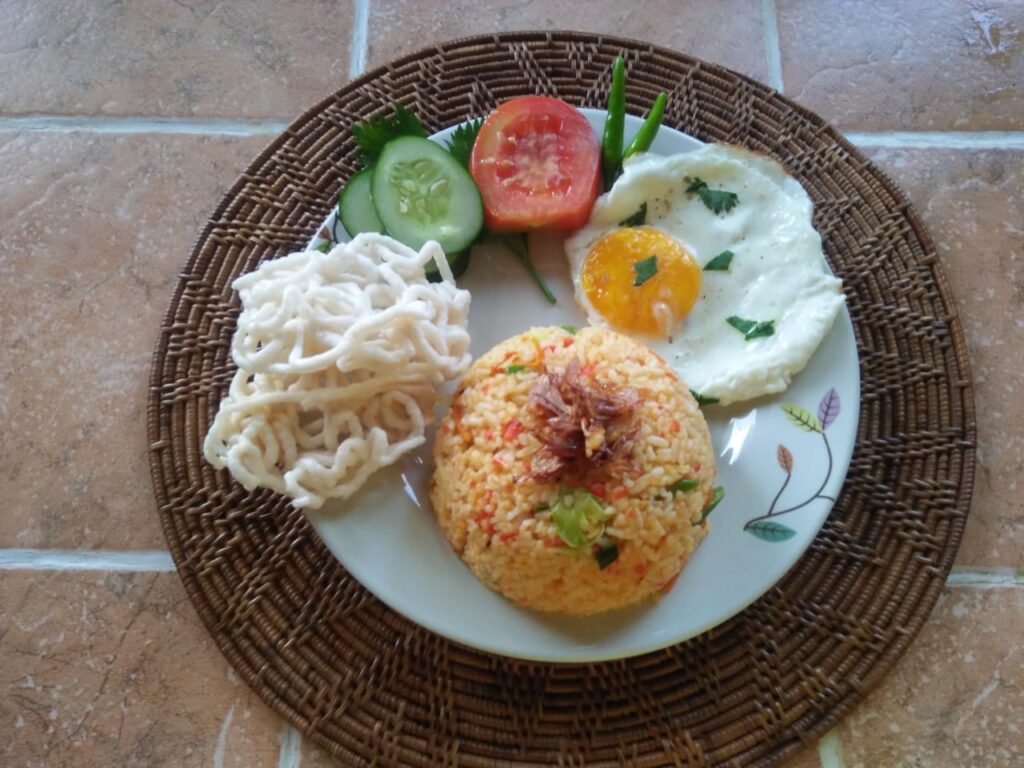
Gretchen’s notes:
Most of the recipes contributed to this site are things I’ve never tried before either – or at least hadn’t tried before meeting these women! Nasi goreng is an exception. I’ve had it several times in Indonesian restaurants in both the US and Germany, so I thought I knew what to expect when Ayu said she would make it for us.
Even so, I was blown away by Ayu’s authentic nasi goreng recipe. The flavors are incredible and rich while still feeling bright and healthful. The overall dish is hearty and filling without being heavy. I could honestly eat this happily every single day.
Don’t be intimidated if a lot of the ingredients sound unfamiliar! You can replace them easily with pantry staples or foods you can find at your local grocery store.
Can You Make This Vegetarian?
Yes! To create a vegetarian version of this dish, all you need to do is use vegetarian seasoning or bouillon instead of chicken seasoning.
Substitution Options
Unfortunately, it’s not always easy to find Thai ingredients all over the world! If you’re struggling with these, here are some substitution options you can use instead. They’re not
Cabe chilis: substitute with any other chilis of your choice. Red chilis are ideal to achieve the same appearance in the finished dish, but you can use green ones instead if you prefer. And if you don’t like spicy food, just use half of a small red bell pepper instead!
Long green bean: substitute a few standard green beans.
Chicken flavor seasoning by Masako: substitute bouillon powder or paste. Alternatively, simply omit this ingredient.
Sweet soy sauce: substitute equal parts of regular soy sauce and brown sugar, each totaling the amount of sweet soy sauce called for in the recipe. For example, if the recipe calls for 1 teaspoon of sweet soy sauce, use 1 teaspoon of regular soy sauce and 1 teaspoon of brown sugar.
Ingredients:
- 1 cup dry rice
- 2 cabe chilis
- 4 garlic cloves, peeled
- 4 shallots, peeled, divided
- 1/2 medium carrot
- 1 long green bean (or 3 standard green beans)
- 1/2 cup cabbage
- 1 green onion
- 2 teaspoons vegetable oil
- 1/2 teaspoon salt
- 1 teaspoon chicken flavor seasoning by Masako (substitute bouillon powder or paste)
- 1 teaspoon sweet soy sauce
To serve:
- 2 eggs
- 1 medium tomato
- 1 small cucumber
- fresh seasonal fruit
- parsley for garnish (optional)
- sambal sauce (optional)
- krupuk (optional)
Instructions:
Cook the rice. Rinse the rice several times in cold water, then cook according to package directions.
Make the chili paste. Cut the chilis in half lengthwise and remove the core and seeds. Cut into 1/2” pieces. Blend along with about 1/4 cup water, the garlic cloves, and half of the shallots until smooth.
Prepare the vegetables. Thinly slice the remaining shallots. Julienne the carrot, discarding the core. Cut the green bean into thin slices on the bias. Cut the green onion into 1/2” slices. Slice the cabbage. Cut the tomato and cucumber into round slices.
Make the crispy shallots. Fry the shallot slices in the vegetable oil over medium heat, stirring frequently, until golden brown and crispy. Remove from the heat and set aside.
Make the nasi goreng. Pour the chili blend into a pan and cook over medium heat until thickened, stirring regularly. Add the salt and chicken flavor seasoning. Stir, then add the sweet soy sauce, carrot, green beans, green onion, and cabbage. Cook for a minute or so, then add the rice. Cook, stirring, for a minute or two to coat the rice in the chili paste and finish the vegetables. Taste and adjust seasoning if necessary.
Serve the nasi goreng. Pack half the rice firmly into a bowl, then flip onto a plate. Repeat with the other half. Fry the eggs, and finish each plate with a fried egg, half of the crispy shallots on top of the rice, a slice of tomato, and a few slices of cucumber. Serve with fresh seasonal fruit, parsley for garnish (optional), and extra sambal sauce (optional). If you can find Indonesian krupuk to serve with it, include those too!
Leave a Reply